Project Overview

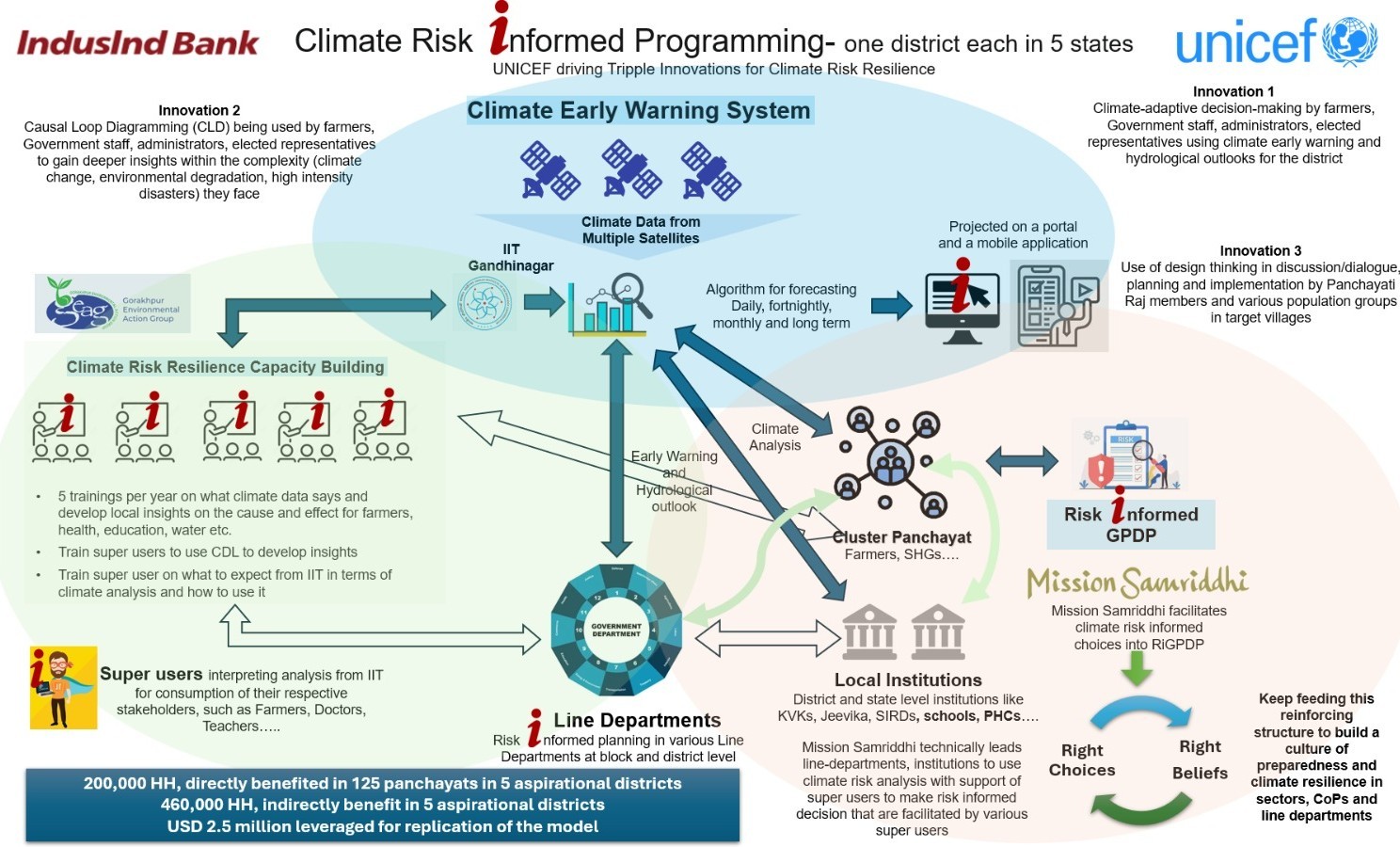
India’s diverse geography ranging from the Himalayan mountain systems and floodplains of the Ganga-Brahmaputra basin to the drought-prone Deccan Plateau and the cyclone-exposed coastal belts makes it highly vulnerable to multiple hazards. Floods, droughts, cyclones, landslides, heatwaves, earthquakes, and soil erosion repeatedly disrupt lives, livelihoods, and infrastructure across the country. Nearly 85% of India’s landmass is exposed to one or more hydro-meteorological hazards, while climate change continues to intensify both the frequency and severity of these events. Erratic rainfall, prolonged droughts, flash floods, rising temperatures, and groundwater depletion have significantly increased disaster risk, particularly in rural and ecologically fragile regions. Unsustainable land use, deforestation, biodiversity loss, excessive groundwater extraction, unplanned settlements, and climate-insensitive development have further amplified exposure and vulnerability. Development investments that are not risk-informed often result in repeated losses, damaged infrastructure, and weakened livelihood systems. Traditional disaster management systems remain largely relief-centric, focusing more on response than on prevention, preparedness, mitigation, and resilience building. Limited access to early warning systems, weak institutional convergence, and poor integration of climate risk information into local planning continue to trap vulnerable communities in recurring cycles of loss and recovery. This calls for a shift toward Climate Risk-Informed Programming (CRIP), where disaster risk reduction is embedded into governance, development planning, and ecosystem management. Such a systemic approach strengthens preparedness, adaptive capacity, institutional coordination, and long-term resilience for communities, livelihoods, and natural ecosystems.


The Challenge We Address

Challenge we address

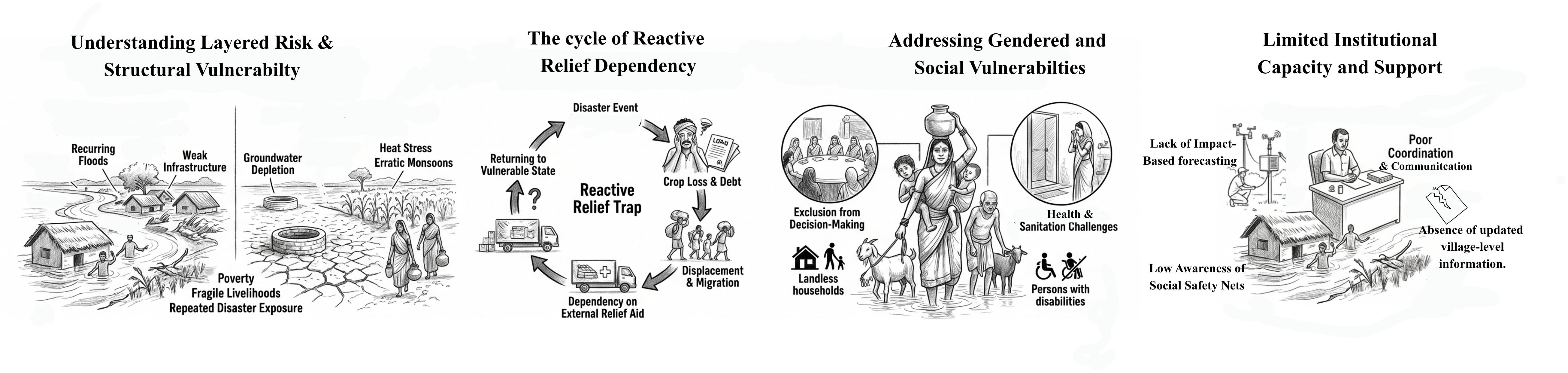
Growing Climate Risks

Climate variability is rapidly transforming rural risk landscapes. The growing impact of climate change across the project geographies can be clearly understood through the following key realities, which reflect how environmental hazards are increasingly translating into deeper social, economic, and developmental

    Vulnerabilities:

  • Climate change is no longer a future threat it is a lived reality that is continuously reshaping the lives and survival systems of rural communities.
  • Escalating Climate Extremes are creating new and compounding layers of vulnerability every year.
  • Recurring Flood Losses in Aspirational districts is pushing already vulnerable households into repeated cycles of loss and recovery.
  • Drought Stress has severely reduced agricultural productivity and weakened household water security.
  • Collapse of Traditional Farming Systems has made traditional farming systems increasingly unreliable.
  • Climate Risk as a Development Crisis has become a permanent development challenge directly linked to poverty, vulnerability, and social inequality.
growing climate risk

Need for Systemic Change

For decades, Disaster management in vulnerable regions has largely remained focused on relief and response providing support after floods, droughts, or heatwaves have already caused damage. While emergency relief is necessary, it does little to reduce the long-term risks that communities face repeatedly year after year.

Short-term solutions cannot solve structural vulnerabilities such as weak institutions, poor planning systems, groundwater depletion, fragile agriculture, or exclusion from government schemes. Relief may help people survive a crisis, but it does not help them withstand the next one.

Systemic change is essential because resilience must be built into the everyday functioning of local governance, agriculture, water systems, health services, and development planning. Institutions need the capacity to anticipate risks, not just react to them. Communities need preparedness systems, not only compensation mechanisms.

Strengthening Gram Panchayats, GPDMCs, VDMCs, and frontline governance institutions at village level ensures that disaster risk reduction becomes part of regular planning and budgeting processes. The goal is not simply to recover from disasters faster, but to reduce the likelihood of disaster turning into long-term distress in the first place.

Our Approach to Resilience